Why Cloud Cost Optimization Matters in 2026 for MSPs
Cloud spending continues to rise across AWS, Microsoft Azure, and Google Cloud, but so does inefficiency. Industry estimates show that 30–40% of cloud resources remain underutilized, directly impacting margins for managed service providers (MSPs) and cloud resellers.
In 2026, cloud environments are more complex than ever—multi-cloud deployments, AI workloads, containerization, and hybrid architectures have increased financial unpredictability. For MSPs, enterprises, and telcos, disciplined cloud cost management is now a competitive differentiator.
Modern cloud financial management combines automation, analytics, governance enforcement, and FinOps best practices to improve cost transparency and protect profitability across hybrid and multi-cloud environments.
What is Cloud Cost Management (FinOps)?
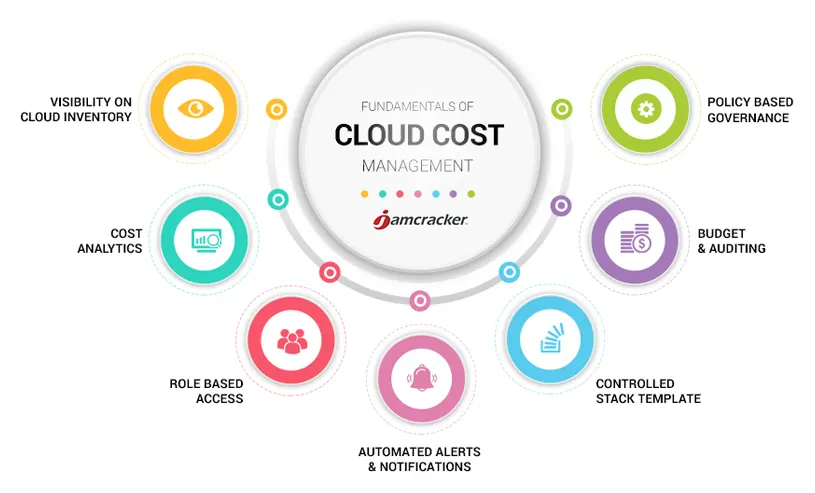
Cloud cost management, also known as cloud financial management or FinOps, is the continuous process of monitoring, analyzing, allocating, and optimizing cloud expenses to maximize ROI.
It extends beyond billing dashboards. Effective FinOps frameworks align engineering, finance, and operations teams around shared accountability, real-time visibility, automated controls, and governance policies.
For MSPs and cloud resellers, this typically includes:
- Tracking cloud costs by customer, project, business unit, or subscription
- Enforcing budget thresholds and role-based access control (RBAC)
- Automating right-sizing and eliminating idle or orphaned workloads
- Implementing showback and chargeback models for customer accountability
- Detecting cost anomalies in real time using AI-powered monitoring
Operational Example: An MSP managing hybrid AWS and Azure workloads implemented automated workload scheduling and idle detection, reducing monthly infrastructure costs by 27% without redesigning architecture.
Jump to proven cloud cost optimization strategies:
Why Structured Cloud Spend Management Is Critical for MSPs
Without disciplined cloud spend management, MSPs and enterprises commonly face:
- Oversized or idle resources inflating monthly cloud bills
- Limited visibility across distributed multi-cloud deployments
- Revenue leakage from unclear cost allocation
- Margin pressure due to inconsistent pricing strategies
- Compliance risks from unmanaged provisioning
- Uncontrolled AI and GPU infrastructure costs driving unexpected bill spikes
By implementing FinOps principles, MSPs improve cost governance, forecasting accuracy, and customer-level transparency while protecting long-term margins.
Explore how MSPs operationalize cloud cost governance using Jamcracker CMP.
10 Proven Cloud Cost Management Strategies for MSPs
- Achieve Unified Multi-Cloud Visibility: Centralize insights across AWS, Azure, GCP, and hybrid environments to detect anomalies, redundancy, and underutilized workloads.
- Deploy a multi-cloud cost management platform that normalizes cost metrics across hyperscalers
- Use tagging strategies to track costs by customer, environment, and project
- Set up automated discovery of orphaned or untagged resources
- Create customer-facing cost allocation dashboards for transparency
- Automate Monitoring and Cost Anomaly Detection: Deploy real-time alerts, AI-powered anomaly detection, and automated remediation to control dynamic cloud consumption.
- Models analyze historical usage patterns, seasonal trends, and baseline spending
- Detects cost spikes within hours (not days or weeks) with minimal false positives
- Automatically correlates anomalies to root causes - overscheduled jobs, runaway queries, inefficient deployments
- Routes alerts to the right team owners via Slack or Jira to reduce mean time to resolution (MTTR)
- Enable AI-powered cost anomaly detection in your FinOps platform
- Set anomaly sensitivity thresholds (e.g., 15% deviation from baseline)
- Configure automated remediation for common issues-automatic shutdown of idle instances, scaling down over-provisioned databases
- Create escalation workflows: alert on anomaly → auto-remediate → notify customer/internal team
- Strengthen Governance and Access Controls: Enforce RBAC, budget policies, tagging standards, and automated shutdown of idle or unauthorized resources.
- Engineering teams provisioning resources without cost awareness often overprovision for safety margins
- Lack of budget enforcement leads to unchecked resource sprawl
- Untagged resources become impossible to allocate to customers or projects
- Standardize Deployments and Resource Templates: Use Infrastructure-as-Code (IaC) and standardized blueprints to reduce provisioning sprawl and maintain predictable spending. Teams using standardized IaC templates reduce provisioning time by 40% and costs by 15-20% compared to manual deployment.
- Optimize Pricing and Purchase Models:
Maximize savings through intelligent use of reserved instances (30-70% discount), savings plans, and spot instances (70-90% discount for fault-tolerant workloads). Modern approach: dynamic commitment management and automated rebalancing as workloads shift. Organizations implementing all pricing strategies reduce total cloud spend by 30-50%.
MSP Insight: Providers combining automated governance with pricing optimization achieve faster ROI compared to cost tracking alone.
- Manage Data Transfer and Network Costs:
- Optimize AI and GPU Workloads
- Optimize Kubernetes and Container Workloads
- Implement Multi-Tenant Cost Allocation and Chargeback Models
- Adopt Continuous FinOps Practices
Why it matters: MSPs managing multiple customer accounts across cloud providers face fragmented billing and visibility. Unified dashboards reveal cost patterns across thousands of resources in real time.
Implementation approach:
Key metric: Achieve 90%+ resource tagging coverage - resources without proper tags become invisible to cost analysis.
The shift from alerts to AI: Traditional cost monitoring relies on threshold-based alerts (e.g., "alert if spend exceeds $10K"). Modern FinOps platforms use AI and machine learning to detect unusual spending patterns without requiring manual threshold configuration.
How AI anomaly detection works:
Implementation approach:
Impact: Organizations using AI anomaly detection identify and respond to cost issues 80% faster than those using manual threshold-based monitoring.
Why governance prevents waste:
Engineering teams provisioning resources without cost awareness often overprovision for safety margins
Data transfer (egress) between regions, clouds, and to the internet represents 15-25% of total cloud costs. Use same-region architecture, CDNs, compression, and private networking to optimize. Monitor transfer patterns and allocate costs to responsible teams.
AI workloads are fastest-growing cost category. GPU optimization strategies: right-size instances (A10G for inference, A100 for general training), use spot instances for training (70-80% savings with checkpointing), implement quantization and batch inference, and pool GPUs across teams. Organizations report 40-60% cost reduction in AI infrastructure.
Kubernetes clusters are often 50%+ over-provisioned. Strategies: right-size pod requests using actual utilization data, consolidate underutilized nodes, use spot instances for non-critical workloads via Karpenter or Descheduler, delete orphaned volumes. Deploy Kubecost or CloudZero for visibility.
For MSPs managing hundreds of customer environments: use virtual tagging for cost re-labeling, track unit economics (cost per transaction), implement showback first (visibility), then chargeback (actual billing). Create tiered models: consumption-based, hybrid, or commitment-based.
FinOps requires ongoing engagement: monthly spend reviews, quarterly optimization cycles, cross-functional alignment, automation of routine tasks, and policy enforcement in CI/CD. Progress through FinOps Foundation phases: Inform (visibility) → Operate (policies/automation) → Optimize (proactive AI).
Case Insight: Reducing Cloud Spend by 28% in 90 Days
A telecom-focused MSP managing multi-cloud customer environments faced margin pressure from rising cloud costs. They implemented a structured FinOps framework with automated idle workload detection, real-time budget alerts, AI-powered anomaly monitoring, customer-level cost allocation dashboards, policy-based provisioning controls, and spot instance optimization.
Results: Cloud spend decreased by 28% (annual run rate from $2.1M to $1.5M), cost reporting accuracy improved by 40%, and customer satisfaction increased significantly. Key success factors: leadership commitment, investment in proper tools, cross-team alignment, and regular optimization cycles.
How Jamcracker CMP Enables Advanced Cloud Cost Management
Jamcracker CMP empowers MSPs, telcos, and enterprises with:
- Unified multi-cloud cost visibility across hyperscalers
- Automated governance and policy enforcement
- Customer-level budgeting and chargeback capabilities
- Advanced analytics supporting FinOps maturity progression
- Integrated marketplace and subscription lifecycle management
By combining automation, governance, and financial intelligence, Jamcracker helps partners transition from reactive cost tracking to proactive cloud financial optimization.
Final Thoughts
Cloud cost management in 2026 is no longer about reducing isolated expenses—it's about building an intelligent, automated, and governance-driven financial discipline that aligns engineering decisions with business outcomes.
Organizations winning in 2026 are those that automate visibility with AI, enforce governance at infrastructure level, optimize dynamically with spot/commitments, align teams around FinOps, and evolve continuously.
MSPs that implement structured FinOps frameworks reduce waste by 25-40%, improve forecasting accuracy, protect profitability, and differentiate through superior cost management. The time to act is now.
Frequently Asked Questions (FAQs)
What are the most effective strategies for cloud cost management?
The most effective strategies include automated cost monitoring, workload right-sizing, governance enforcement, unified multi-cloud visibility, and continuous FinOps-driven budgeting and forecasting.
How can MSPs reduce cloud spending efficiently?
MSPs reduce cloud spending by implementing automated idle resource detection, enforcing RBAC-based governance, optimizing pricing models such as reserved instances, and centralizing cost visibility across customer environments.
What about AI and GPU cost management?
GPU optimization includes: right-sizing instances, using spot instances for training (70-80% savings), quantizing models, batching inference, pooling GPUs, and using specialized commitments. Organizations report 40-60% cost reduction in AI infrastructure.
Which tools support cloud spend management?
Common tools include AWS Cost Explorer, Azure Cost Management, Google Cloud Billing, and multi-cloud FinOps platforms such as Jamcracker CMP that provide unified visibility and governance automation.